English
8/7/2026
Letter to the Executive Committee of the Frente de Izquierda Unidad
Seguir
Over the weekend of May 23, 24, and 25, the Partido Obrero held its 30th Congress. Collectively, we analyzed the national and international situation and focused particularly on the tasks facing the Frente de Izquierda Unidad (FITU) in light of the growing support the left has gained among a broad segment of the working class. We believe that the polls showing widespread support for Myriam Bregman and the Frente de Izquierda reflect a very progressive political process that presents all of us—the parties that make up the FITU—with a challenge greater than any we have faced in the past.
The growth that our FIT-U has been achieving—though it is a long-term process—has now been bolstered by the struggle we have waged against Javier Milei’s libertarian government. In a dark and difficult time for working people, with a government that embodies the greatest capitalist offensive since the dictatorship to date, the left has been and continues to support the struggles in the streets and also to confront the government within Congress. This stance, widely recognized by the best of our people, stands in contrast to the various factions of Peronism and the CGT bureaucracy, which wavered between complicity and impotence in the face of the government. At its core, what appears on the surface as a timid attitude is nothing more than the class interests embodied by Peronism itself. After all, it is only natural that those who want to govern on behalf of the Paolo Roccas and Madanes Quintanillas will not fight against labor reform, just as the governors who for years have been handing over natural resources to the mega-mining companies will not defend the Glacier Law.
Now that Milei’s government is entering a major crisis—as a result of the failure of its economic model, internal divisions, allegations of corruption, and, most notably, the well-deserved anger of millions of workers who hold him responsible for their daily hardships, we see that Peronism is trying to distance itself from its complicity with the government by proposing an “anti-Milei front” that ranges from Pichetto to the FIT-U. On social media, people are posting that they would like a Kicillof-Bregman ticket, while they are working on an agreement not only with the right wing of Peronism but also with sectors of Macrism. They cite the Brazilian experience, where Lula came to power with an “anti-Bolsonaro front,” omitting the fact that under the PT leader’s presidency, Temer’s labor reform and Bolsonaro’s pension reform remain in effect. The presence of leftist leaders in Lula’s government—such as Boulos of the PSOL—has not altered the capitalist and conservative nature of that government in the slightest. While they’re trying to lecture us on how to confront the right, just a few days ago, part of Lula’s coalition voted in the Brazilian Congress to significantly reduce Bolsonaro’s sentence for having instigated an attempted coup following his defeat in the last presidential election.
At our Congress, we characterized the “anti-Milei front” as a ploy to conceal Peronism’s collaboration with the libertarian government and to try to undermine the political independence of the left. And, as part of this maneuver, to shift the entire debate toward what we will do in the 2027 elections, setting aside the urgent need for all popular sectors to confront the government and the capitalists right now. Our duty, on the other hand, is to organize resistance to the capitalist offensive right now by supporting and promoting direct action by workers and, at the same time, building a political alternative for the left and the workers.
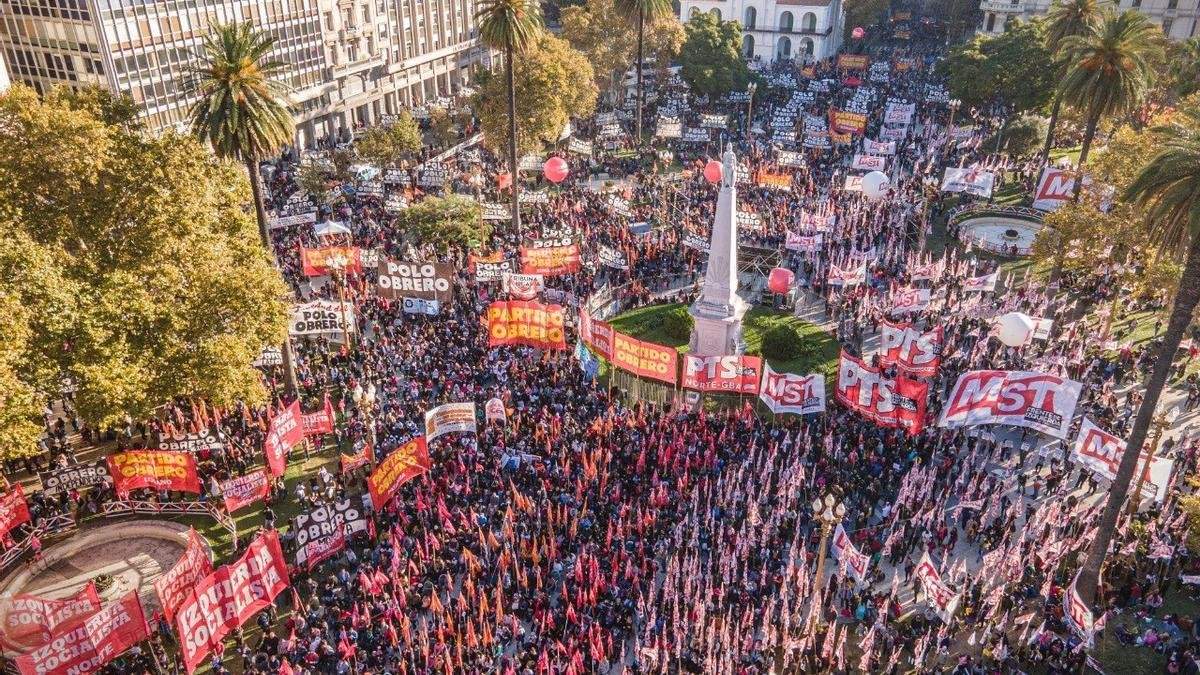
At the May 1 rally in Plaza de Mayo that we held with our comrades from the MST and Izquierda Socialista—which was also attended by Vientos del Pueblo and many FIT-U supporters—we in the Partido Obrero formally proposed that we jointly convene a National Assembly of the FIT-U open to all grassroots activists. Such an assembly could be prepared at the local level, through open meetings in the provinces, within the labor movement, on college campuses, and in working-class neighborhoods. By following this path, we would move toward giving an organized form to the support the left is garnering, knowing that otherwise we run the serious risk of seeing that support dissipate.
Although we have not yet been able to discuss this proposal at a meeting of the FIT-U National Executive Committee, we have taken note that there are differing opinions and proposals regarding the policies and initiatives we should adopt. The PTS leadership has stated that it views the proposal as “treading water” because “either we transform the sympathy for our leaders into organization—as we have been arguing throughout this interview—or we will fail to ensure that the class-based left can decisively influence reality.” But a National Assembly of the FIT-U—prepared through prior local assemblies and meetings in workplaces, schools, and working-class neighborhoods—is precisely intended to transform sympathy into organization. Given that we share the same objectives, it is urgent that we meet to coordinate our proposals.
At our Congress, we also took note that our comrades from the PTS announced a campaign to form committees and are calling on the parties of the FIT-U to participate and organize them jointly. We believe this is the right approach and accept the proposal. We believe that a key task of these committees is to debate both the program for overcoming the crisis and to adopt concrete initiatives for action to confront Milei and the capitalist offensive now, without waiting for the elections. The issues to be addressed are as broad as the popular resistance we want to build: the struggle against layoffs, for higher wages, against the implementation of labor reform, in defense of education and health care, the environment, and against repression—all of which must culminate in the struggle to oust Milei through a general strike and build a left-wing, workers’ alternative. Of course, on the international front, we must support the struggle of the Bolivian people and oppose imperialist war and the genocide against the Palestinian people. We are confident that any differences that may arise can be addressed in the debate itself, prioritizing points of agreement and concrete actions.
Our comrades in the PTS have also indicated that they want to move forward with the formation of a Workers’ Party. This is, of course, a very serious matter. In the letter they sent to the FIT-U executive committee, our comrades in Izquierda Socialista have asked the PTS to clarify the nature of this proposal. We addressed this issue at our 30th Congress. Since its founding, the Partido Obrero has been fighting to build a revolutionary party of the working class. Given the current conditions of the historic bankruptcy of capital and the trends toward war, we believe that now more than ever a party of this kind must have a clear program based on the strategy of workers’ government, understood as the popular formulation of the dictatorship of the proletariat. This requires complete political independence from all variants of the system without exception, and a debate on a political strategy that must be based on a common understanding of the tasks facing us in the face of the capitalist crisis and war, which are the defining factors of the global situation. A party of this kind requires an organizational structure in line with its strategy and an appropriate method. For us, that organizational structure is democratic centralism, and the method is the class struggle, subordinating electoral participation to the strategic objectives dictated by the program.
We bring this understanding to the debate initiated by our comrades in the PTS. Knowing that the formation of a party is—we repeat—a serious matter, we do not want to allow that debate to paralyze our action on the many points where we agree. We reiterate that our proposal for a National Assembly of the FIT-U, open to all activists, would be a valuable step in that direction. It could serve to provide a unified vision for all the committees we establish in workplaces, schools, and working-class neighborhoods. We also believe that a good way to begin this process would be to hold roundtable discussions with the participation of the FITU parties and other comrades who wish to take part. The presence of various intellectuals and artists committed to our cause could also be very helpful.