English
8/7/2026
The Frente de Izquierda-Unidad’s debate forum opened to a full house

Seguir
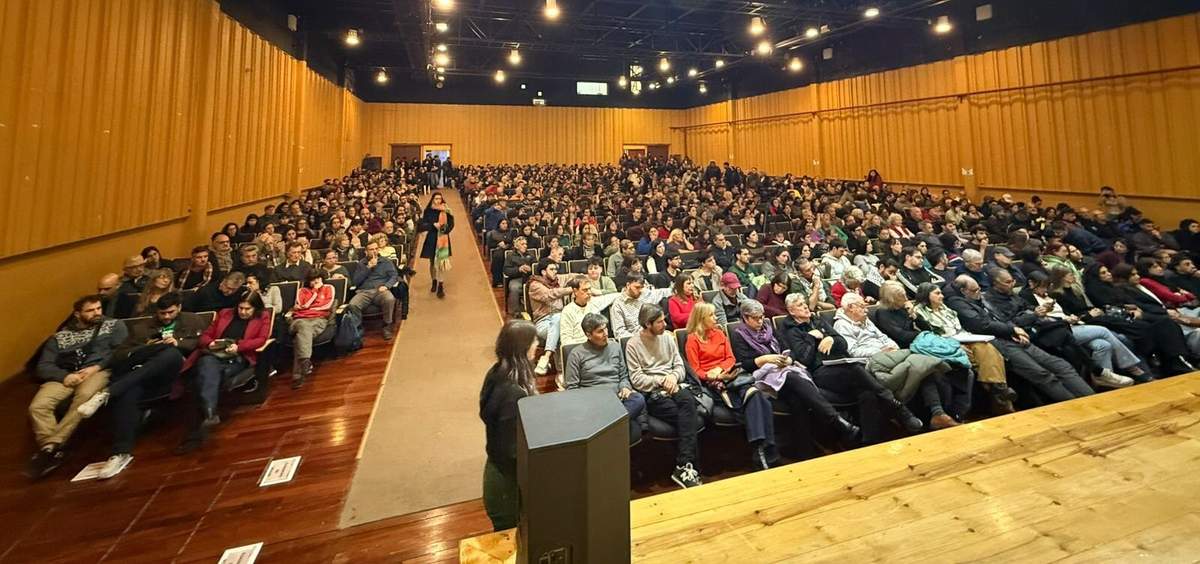
First meeting of the forum “The Paths, the Method, and the Program,” aimed at turning the shift to the left into an organized force of the working class.
The first meeting of the discussion forum organized by the Frente de Izquierda filled the auditorium at the UBA’s School of Social Sciences.
Before an audience of about a thousand people, leaders of the four parties that make up the FIT-U outlined their positions and contributed to the open discussion taking place not only among left-wing activists but also among broad sections of the population, driven by growing support for the Frente de Izquierda and the figure of Myriam Bregman. Titled “The Paths, the Method, and the Program,” the forum aims to translate this favorable sentiment into an organized force of the working class.
Gabriel Solano and Vanina Biasi spoke on behalf of the Partido Obrero and debated with leaders Christian Castillo and Laura Liff of the PTS, Mercedes de Mendieta and Juan Carlos Giordano of Izquierda Socialista, and Sergio García and Alejandro Bodart of the MST.
The debate focused primarily on how to respond to the shift to the left among a significant segment of the population—and especially among labor and grassroots activists—in the face of Milei’s policies and Peronism’s collaboration in supporting attacks on workers as a whole.
Members of the Partido Obrero and Izquierda Socialista focused their proposals on the need to establish unified FIT-U committees, in contrast to the PTS’s decision to organize its own committees while excluding the other organizations.
Vanina Biasi did so by emphasizing that the proposal to establish unified committees and a national assembly of the Frente de Izquierda is intended to address not only programmatic discussions but also the actions to be taken in the class struggle. In light of this process, she underscored the value of the slogan “Out with Milei” as a perspective for the popular movement—one that is also valuable as a contrast to Peronism’s collaboration with the government’s attacks.
She called on the PTS to reconsider its opposition to establishing joint FIT-U committees—as well as on the MST—to carry out a political mobilization against the government, illustrating this with an invitation to join the action voted on by the plenary held in La Matanza in front of Mercado Libre, a symbol of the precarious-labor-exploiting bosses who are getting rich off Milei. She argued that this is a step forward toward ensuring that the radicalization of the bourgeoisie in its offensive against workers is met with a radicalization of the popular sectors, within which she highlighted the role of the piquetero movement amid the impoverishment of the labor movement.
Vanina clarified that, regarding the war in Ukraine, “the slogan ‘neither with Putin nor with NATO, for an independent resistance,’ as proposed by the PTS, is not the same as revolutionary defeatism in the face of an interimperialist war,” refuting Castillo’s assertion on the matter.
In turn, Juan Carlos Giordano of IS criticized the PTS’s decision to split the FIT-U on May 1—when, he noted, it could have put forward its proposal—and its decision to launch committees under its own slogan, while not allowing other forces within the FIT-U to participate. He pointed out that the criticism of the FIT-U’s “limitations” by those who argue that it “has fallen behind,” that it “is not enough,” and that it is “routine” in nature, raises the question of whether the proposal for a new workers’ party (which “the PTS must clarify”) is not, in fact, the PTS itself. Giordano pointed out that, far from being routine, “the unitary committees are something new; they are not just more of the same; they have never existed in the past 15 years; it is a revolution within the FIT-U.” He also noted that the PTS fails to recognize the importance of the Plenary of Combative Trade Unionism for a new direction for the labor movement.
Alejandro Bodart focused his remarks on the need to capitalize on the political shift, but to do so, the FIT-U must transform itself into a common organization, “a great workers’ party, a party of the left, a new historic movement—a unified organization among the various forces of the FIT-U or those who accept this challenge,” in which the current forces that make up the FIT-U become internal currents or tendencies, and if there are differences, “the membership should vote.” Democratic centralism, according to Bodart, would arise from the commitment of all factions to respect the majority decision. The difference from the failed experience of broad-based parties, according to Bodart, is that there is a revolutionary program—that of the FIT-U. The importance that the MST places on the need for a common organization—but one divided into tendencies, which would crystallize the division—is not expressed through participation in common and unitary committees, which require prior agreements.
Christian Castillo, after spending several minutes discussing the PTS’s self-proclamation, stated that “if we have programmatic differences, the political constraints on moving forward (in a joint party) are complicated.” And on that basis, he once again rejected the proposal for joint committees. He countered this with a proposal to establish coordination committees comprising all the parties of the FIT-U and their allies, along with all the militant unions and shop steward councils, in every part of the country, thereby laying the groundwork for “workers’ councils, soviets, and action committees to organize and break through passivity.” But this approach does not address the need to build a political force of the working class, which is the committees’ greatest challenge.
In his concluding remarks, Castillo explained and proposed the establishment of regional coordinating committees to advance the struggle, contrasting them with the Plenary of Combative Trade Unionism (PSC)—which includes the reclaimed unions, many internal committees, the piquetero organizations, retirees’ groups, and class-conscious factions—without explaining why these coordinating committees would address the shortcomings he attributes to the PSC.
He said that the PSC is “an agreement among leaders,” ignoring the fact that it emerged from a unified plenary session of 1,000 activists with committees that deliberated on August 16, preceded by another massive gathering at Luz y Fuerza in Córdoba, and that more recently brought together 650 activists at Parque Lezama to protest against the slave-like labor reform. In addition to co-organizing, along with Sutna, a general assembly in San Fernando that organized a march to Plaza de Mayo against the layoffs, they also participated in numerous other demonstrations held at various times, about which Castillo said, “We participated.”
The PTS leader questioned whether the committees could act and intervene in the class struggle, arguing that, as part of the FIT-U, they would set a limit; at the same time, he wondered how differences over action within the committees should be resolved and whether a vote should be taken. Again, these reservations cannot lead to a rejection of the joint committees.
Gabriel Solano emphasized that the historic opportunity now opening up for the revolutionary left does not mean that “we are close to taking power,” because a working-class government requires that the working class be politically organized independently. That is why he emphasized that the most important aspect of the rise shown in the polls is how to give it an organized character in order to influence the class struggle and alter the class relations that are currently unfavorable to workers—as reflected in Milei’s announced offensive against 800 collective bargaining agreements.
He emphasized the importance of unitary committees and a national assembly of the Left Front to carry out the struggle against the union bureaucracy and Peronism, which is calling for an “anti-Milei front” in the hope of blocking the trend toward class independence through a populist-front co-optation. Since Peronism does not compromise with Milei out of cowardice but rather because it defends the social interests of the capitalist class, we must confront it by giving strategic direction to our support for the FITU. The goal is to establish the left as a political pole for the Argentine working class—a role it does not yet play.
During the concluding remarks, Solano reiterated that, unlike other situations in which the emergence of a Workers Party represented a step forward in the trend toward class independence, today in Argentina that trend can only be expressed within the Frente de Izquierda against Peronism. He also emphasized that holding joint committees and a national assembly makes it possible to explore ways to move forward with action and engage in a strategic debate on the methods and program for building a revolutionary party.
A revolutionary party, he concluded, should be based on democratic centralism as its method, rather than on a “party of tendencies” in which each party within the FIT-U would become a tendency, continuing along the same lines as exists today. With the strategy of a workers’ government and the program of expropriating capital for social reorganization, the aim is to fight to put the working class on the offensive, which would serve as a model for the working class of Latin America and the world, in opposition to the wars and crises to which capitalism condemns us.