English
28/7/2026
MANIFESTO OF THE PARTIDO OBRERO
A contribution to the development of the left and socialism in Argentina
Join us in building a workers’ alternative.
Seguir
Introduction
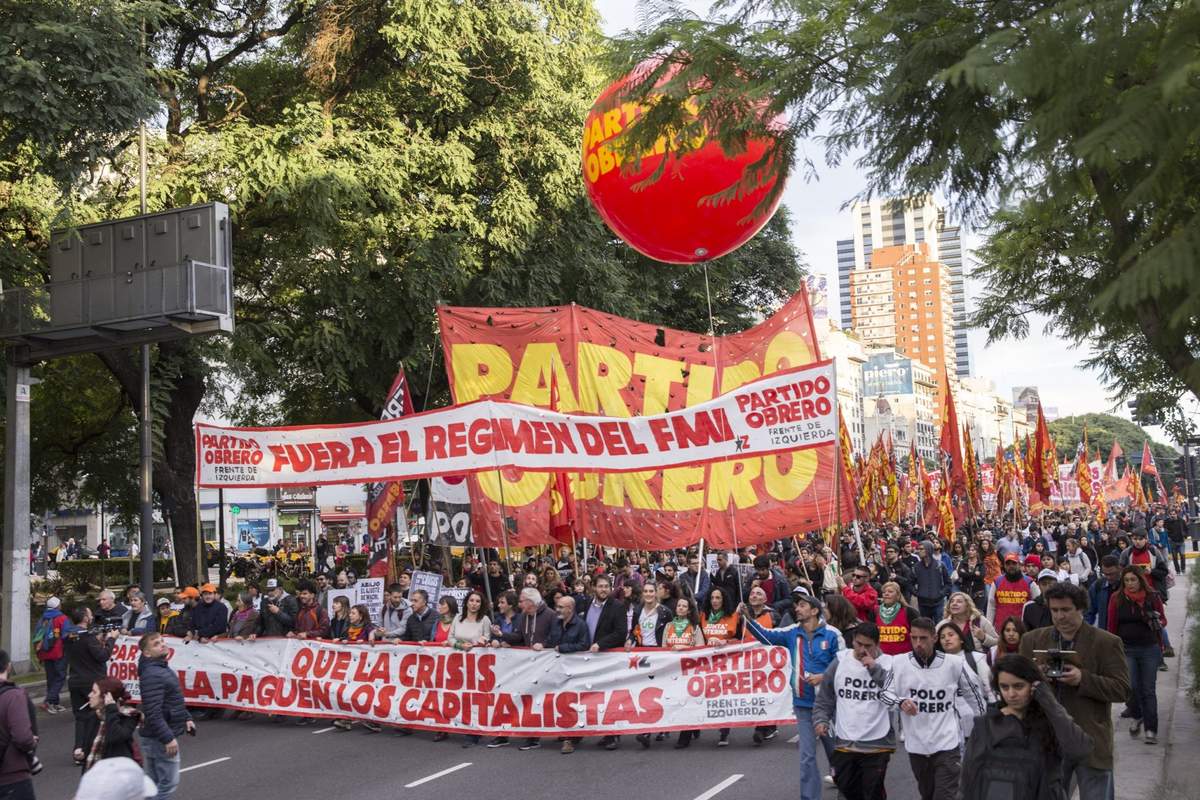
The manifesto presented below is a contribution by the Partido Obrero to the debate that has begun within the FIT-U and which involves both the wider left and the working-class sectors seeking to build an independent political alternative, opposed to Milei’s government and the employers’ opposition. This debate has become urgent and necessary due to the rise in popular support for the FIT-U and, in particular, the poll ratings for Myriam Bregman’s candidacy. Millions of workers, who in the past paid attention only to the capitalist forces, are now looking to the left and want to know what its strategy and programme are. The question of what the left would do if it came to power is no longer a discussion confined to a circle of activists; it has become part of the national political debate.
For the parties that make up the FIT-U, the challenge ahead is immense. Presenting a clear programme and strategy has become a necessary condition for accelerating this political shift to the left. A radical critique of capitalist society must be combined with a socialist programme to resolve the current crisis. Alongside the programme, we must address another crucial issue: what kind of political force we must build, and what sort of government and state we need. These are closely interlinked issues, which cannot under any circumstances be addressed in isolation, nor can the national and international levels be separated in their treatment. Nor can these fundamental questions be separated from how we confront Milei’s far-right government, which presents itself as the vanguard of Trumpism in Argentina and Latin America. Our struggle for workers’ government and for socialism begins with the struggle to bring down Milei’s ‘liberfacho’ government through a historic workers’ action. The united committees of the FIT-U that we in the Partido Obrero have been proposing face the challenge of combining all the tasks outlined: driving forward direct action against the government and the capitalist class; deepening the debate on strategy and programme; and advancing the building of a political force of the working class and the left that fights for a workers’ government.
The ongoing debate is open and inclusive. We call on workers, the struggling youth, and those sectors of the intelligentsia and cultural sphere who wish to build a left-wing and socialist alternative to the oppression and barbarism of capital to make this their own.
I. Down with imperialist war
The defining feature of the current international situation is the escalation of imperialist wars and the genocides they entail. For more than four years, a war has been raging in the heart of Europe, pitting NATO against Russia on Ukrainian soil. On the battlefield, the dead number in the hundreds of thousands and the wounded in the millions. Trump promised he would end the war on the first day of his term. But the opposite happened: not only did the war in Ukraine continue, but it spread to new territories and countries, taking on an international dimension. Since October 2023, Zionism, with the support of US and European imperialism, has intensified its aggression against the Palestinian people. The genocide in Gaza has led to the extermination of almost 10 per cent of its population. The images and videos circulated on social media have depicted, in real time, a genocide carried out with the complicity of the so-called ‘international community’. Zionist expansionism has not been confined to Gaza. Pursuing the dream of a ‘Greater Israel’, the war criminal Netanyahu attacked the West Bank, Lebanon, Syria, Yemen and Iran in conjunction with the United States. Zionist messianism, however, is nothing more than the ideological guise for US imperialism’s attempt to reshape the Middle East in line with its war plans against China and Russia and to further subordinate the European powers. We are not simply facing a series of regional conflicts, but rather different manifestations of a trend towards a world war.
The escalation of wars cannot be explained by Trump’s personal ravings. The expansion of military confrontations is rooted in the capitalist system itself. That is why, in the United States, wars have escalated under both Democratic and Republican administrations. For US imperialism, the aim is to reverse its increasingly pronounced historical decline by drawing on its colossal military machinery. But it is far from achieving its objectives. Military aggression against Iran has so far failed. Trump failed to achieve any of the objectives he proclaimed and was forced to back down before the Ayatollahs’ regime for fear of a worsening crisis within the United States itself. Even Israel, despite all the brutality of its murderous machinery, has failed to subdue the Palestinian people.
Militarism is spreading like wildfire and engulfing the vast majority of states. The European powers have resolved to increase their military spending, stepping up their preparations for war. Even peripheral nations have taken the same course, allocating an ever-greater portion of their budgets to the purchase of military equipment. The flip side of this militarism, which fuels the profits of the arms industry, is the escalation of austerity measures against the peoples of the world. The purchase of aeroplanes, tanks, drones and missiles comes at the expense of pensions, social welfare and the underfunding of health and education systems worldwide.
‘War is nothing more than the continuation of politics by other means’. And politics is nothing other than ‘concentrated economics’. The fact is that capitalism, in its imperialist phase, faces crises that are increasingly acute, prolonged and profound. The backdrop to this is a historic crisis of capital and its tendency towards collapse. This is evidenced by the fact that, even now, capital has been unable to overcome the 2008 crisis, despite the fact that almost 20 years have passed. The shockwaves of this crisis continue to be felt to this day, dictating the actions of governments and states. The governments of the major powers, starting with the United States, resorted to multi-billion bailouts to save bankrupt capital, leaving the states heavily indebted. This colossal debt is the root cause of the dollar’s decline, the crises in monetary systems, and the inflation that coexists with economic stagnation. The growing devaluation of the dollar and US government bonds – the foundation of the global financial system – coincides with the growing crisis of post-war imperialist institutions, from NATO to the WTO. We are witnessing a crisis of the prevailing imperialist order, including a significant decline of the European powers and Japan.
The decline of the United States and of imperialist capital has gone hand in hand with the rise of powers competing with it for global hegemony. The principal among these, of course, is China. The rise of the Asian giant has exacerbated the trend towards overproduction of capital and commodities on a global scale, intensified global competition between states and monopolies, and deepened competition within the working class itself. But the Asian giant itself has not remained immune to capitalist bankruptcy, as demonstrated by its property crisis, the progressive slowdown in its economic growth and its high level of debt. This process has been accompanied by a rise in inequality and social antagonisms within China. Those who subscribe to a ‘campist’ view that attributes a progressive character to China and Russia in opposition to traditional imperialism not only overlook both states’ ambition to establish themselves as imperialist powers, but also fail to take into account that the Communist Party of China has been a decisive driving force behind the destruction of the working class’s gains on a global scale.
The struggle against imperialist war can only be waged consistently insofar as it is a struggle against capital, its states and its governments. Our slogan is ‘down with the governments of war’ and we call on the workers of the world to mobilise towards that aim. But we are not pacifists. Whilst we fight to put an end to imperialist wars, we defend the right of oppressed nations to rise up against imperialist aggression and colonisation. We stand with Iran against US imperialism, we defend the Palestinian people’s right to rebel against Zionism, and we fight for the victory of all national wars against global imperialism by promoting the independent mobilisation of workers.
II. Latin America
The decline of the United States and the rise of China will not lead to a multipolar world, as the defenders of capital would have us believe. Capitalism is a system of global competition. The forces of production have taken on an international dimension and cannot be confined to the national level. Trump’s protectionism does not seek to confine US capital within its national borders but rather to launch a fierce offensive against its rivals. This is what we are seeing in Latin America with US imperialism’s attempt to regain control of its ‘backyard’, which is under threat from Chinese competition. The Asian giant has become the main trading partner of most countries in the region, including those with governments allied to Trumpism.
The ‘Shield of the Americas’, signed by Latin America’s right-wing governments, has already been put into practice in Venezuela, which has been turned into a US protectorate by the remnants of Chavism. Whilst right-wing governments, openly aligned with Trump, supported US interventionism in Venezuela, centre-left and nationalist governments confined themselves to expressing “concern” and calling for a “peaceful and negotiated solution”. Now, imperialism is besieging Cuba with a criminal blockade and threatening it with possible military intervention. ‘Progressive’ governments, such as Lula’s in Brazil and Claudia Sheinbaum’s in Mexico, whilst not joining the pro-Trump camp, comply with and enforce the oil blockade against Cuba. And the Cuban government, for its part, is acquiescing to a policy of opening up to capitalism that is paving the way for the semi-colonisation of the island.
The rise to power of right-wing and far-right forces in Latin America has been paved by nationalist or centre-left experiments which, for the umpteenth time in the continent’s history, have proved incapable of breaking free from imperialist tutelage, leading a process of national emancipation, and responding to the most basic aspirations of the working masses. This assessment applies with particular force to Chavism, which was the most radical variant of the nationalist movements and which, for a time, sought to masquerade as socialism, as if it could be the work of a military clique rather than the working class.
The electoral victories of the right do not rule out the possibility of a militant outbreak by the workers in the social and political process. The brutal austerity measures against the people and the shameless sell-off of national resources may act as triggers for popular intervention. Whilst Chile’s Kast made his debut facing a massive student mobilisation against cuts to education and public services, the extraordinary rebellion of Bolivia’s workers and peasants has once again placed the spectre of popular rebellion on the Latin American agenda. The Bolivian picket lines and demonstrations combined the urgent demands of workers and peasants with the call for the ousting of President Paz. The latest betrayal of the popular uprising by the Bolivian Workers’ Confederation (COB) has once again highlighted the importance of the struggle to reclaim workers’ organisations and establish class-conscious leaderships.
The Workers’ Party supports all the struggles of Latin American workers and peasants and stresses the need to wage a united struggle for the expulsion of imperialism and for the socialist unity of Latin America. We denounce imperialism’s criminal blockade against the Cuban people; we join the call by the oil workers of Rio de Janeiro, who have launched a campaign for Lula to stop selling oil to Israel and to provide immediate aid to Cuba.
III. Milei and the far right
The tendencies towards imperialist war are reflected on the political stage by the proliferation of far-right governments. We are witnessing reactionary political formations whose strategic function is to utilise the state’s economic, political and repressive resources to launch an offensive against the working class in each country, with the aim of dismantling their hard-won gains and increasing the profits of capital. These class objectives take precedence over ideological facades, which often take contradictory forms. This is the case, for example, with Trump and Milei. Whilst the White House thug flaunts state interventionism and economic protectionism, Milei presents himself as an ‘anti-state’ figure. However, once again, behind the apparent ideological differences lies a consistency of class interests. There is a direct link between Trump’s protectionism in an imperialist country and Milei’s liberalism in a semi-colonial country, leading to the colonisation of Argentina by US capital and turning the country into a link in the supply chain of the United States and its military and security industry.
Milei’s government does not merely have the support of Trump and the US embassy. From a broader perspective, Milei is realising the aspiration of the entire propertied classes to radically alter the relationship between the social classes in Argentina. The labour reform, which Milei is rushing to implement by threatening to scrap 800 collective bargaining agreements at a stroke in order to impose flexible, company-specific agreements, represents the war programme of the entire capitalist sector against Argentina’s workers. Should he succeed, Milei will have gone further than Videla and Massera in reducing our country’s working class to a state of semi-slavery.
The national bourgeoisie and even the so-called SMEs complain about the government’s open-door policy on imports and the fact that the exchange rate is ‘lagging behind’. Yet they do not for a moment wish to lose the gain that the elimination of collective bargaining agreements represents for capital – and, even more so, the blow to workers’ trade union organisation, the right to strike and the right to assembly. In recent months, Techint and Milei have been involved in fierce public disputes. Yet Paolo Rocca, the owner of Techint, has placed Julio Cordero – who was one of his managers – at the helm of the Ministry of Labour to oversee the implementation of the labour reform. Not only that: through the courts, he is also pushing ahead with the intervention in the UOM with the aim of imposing a trade union that is completely subservient to employers and turns its back on workers, who suffer from job insecurity and the erosion of their wages. At the same time, this ‘slave-like’ reform paves the way for the formation of company-based trade unions.
The economic policy pursued by Milei fully serves the interests of financial sectors that are making fortunes in Argentina whilst, at the same time, the crisis in industry, construction and commerce is deepening. The RIGI and Super RIGI schemes grant extraordinary benefits to mining and oil monopolies, as well as those in the new technologies sector, steering the country towards a heavily deindustrialised and primary-sector-based economy. These benefits include a drastic reduction in social security contributions for large monopolies. In fact, a clearly regressive tax reform is being implemented. Taxes, characterised as ‘theft’ by libertarians, remain in place and are even being increased for workers and the working classes. In contrast, they are being significantly reduced for capitalists. The entire libertarian agenda is moving in this direction. The economic groups that gained the most did so as a result of government decisions. With the rise in tariffs and service charges, energy concessionaires and business owners profited. With the reduction in export duties, the agri s reaped the benefits. With sky-high interest rates and a suppressed exchange rate, financial capital involved in carry trade came out on top. With the establishment of the Labour Assistance Fund, employers’ organisations stand to gain, as they can make workers redundant at no cost by using pensioners’ funds. Libertarian interventionism benefits the capitalists whilst workers bear the brunt of it, as they are denied collective agreements that exceed or even match the rate of inflation.
With the nefarious Sturzenegger at the helm, Milei’s government is inviting the national bourgeoisie to reinvent itself by entering the business cycle engineered by the state. Let industrialists downsize or close their plants and switch to becoming importers. Let the capitalists with special tax regimes in Tierra del Fuego enter the energy business. Let capital take advantage of the penetration of mining monopolies to supply them with certain inputs, for polluting production destined for export and with no added value. But this restructuring, which allows the national bourgeoisie to maintain its privileges, operates very differently for workers. An industrial worker, with health insurance and pension contributions, moves to a gig economy platform under a single-tax scheme. This type of restructuring has clear limits. In March of this year alone, more than 2,000 companies closed, adding to the 26,000 that have closed since Milei became president in December 2023. Far from reversing this trend, March this year was the worst month since Milei took office. Alongside this, thousands of jobs were lost and the single-tax scheme stopped growing. It is no longer just formal employment that is falling; informal employment is also declining.
The libertarian ‘chainsaw’ wielded against the people is far from having created a picture of stability. Milei managed to survive thanks to bailouts carried out first by the IMF and later by the US Treasury. Without them, his government would have been blown to smithereens. To weather the crisis, Minister Caputo – an agent of the investment funds – resorted to a massive issuance of peso-denominated debt, which is not factored into the fiscal deficit because the interest is capitalised. Furthermore, with the slump in economic activity combined with cuts to capital taxes, tax revenue continues to fall, affecting central government spending, whilst the provinces are making even deeper cuts to public health and education. The contradictions accumulated as a result of the ‘ ’ government’s economic policy are explosive. If Trump is defeated in the November US elections and Milei is left without his lender of last resort, we cannot rule out a deep financial crisis.
Whatever scenario ultimately prevails, the fact remains that the continued rule of the Milei government poses a threat to workers. Those who refuse to confront him now, predicting a certain defeat for the libertarians in next year’s elections, are not only allowing the labour reform, wage cuts and Milei’s entire war plan to go ahead, but are also giving Milei a new opportunity to strengthen his position and secure re-election. It is on the basis of these considerations that the Workers’ Party calls for “Milei Out – General Strike”. The struggle to bring down Milei’s government through a historic, independent action by the workers also marks a clear break with all the factions of the capitalist parties that claim to be in opposition but which, in practice, collaborate with the libertarian government – whether by voting for its laws in Congress, implementing its policies in the provinces and municipalities where they govern, or paralysing the workers through the trade union bureaucracy aligned with the PJ.
IV. The role of Peronism
Since December 2023, we have repeatedly pointed out that Milei does not govern alone. To push through legislation in Congress, he relied on the support of Peronism, Radicalism and the provincial parties that answer to local oligarchies. The governors affiliated with these political forces pressured their deputies and senators to vote in favour of key government bills, such as the Framework Act and the amendment to the Glaciers Act. In doing so, they remained loyal to their parties, which for decades have governed the provincial states in alliance with the major international mining and oil conglomerates. This is particularly true of Peronism, which has transformed entire provinces into free rein for mining plunder. There is no faction of Peronism that is not aligned with this policy – from Kirchnerism in Santa Cruz to the Peronist movements in northern Argentina.
The discredit already attached to Peronism due to the failure of the Frente de Todos government has been compounded by its complicity with Milei’s government. Peronist governors have not hesitated to vote for libertarian laws in Congress and to offer themselves as partners to Milei and s in their respective provincial governments. The Jaldos of Tucumán and the Jalils of Catamarca have been the most blatant examples of this collaborationism. But Kirchnerism, which poses as the opposition, has not been immune to this policy. Directly, Peronist senators – both those loyal to CFK and the rest – struck a deal with Milei’s camp regarding the composition of the Supreme Court by providing the signatures required for the submission of Ariel Lijo’s nomination. They also voted alongside Milei in favour of the 2024 money-laundering amnesty, the SIDE budget administered by Caputo and used for political espionage, and the laws on recidivism and repeat offences promoted by Patricia Bullrich to persecute activists, amongst other concrete acts of political collaboration. For the time being, in the most recent elections they have stood on joint lists with the governors. This unity has not been merely electoral. In her most recent letters, Cristina Fernández de Kirchner spoke out in favour of ‘labour modernisation’, the term Milei borrowed to describe his anti-worker labour flexibility bill. The former president also aligned herself with libertarian rhetoric by questioning the so-called ‘present state’ in favour of an ‘efficient state’ and joining the attack on teachers, whom those in power blame for the education crisis.
Peronism’s complicity and impotence in the face of Milei are rooted in the class interests it has historically represented and wishes to continue representing. As the party of the so-called “national bourgeoisie”, Peronism acts in defence of an exploitative and oppressive class. That is why it does not challenge the labour reform nor call for a fight to have it repealed. Neither does the official trade union bureaucracy, which did not and does not fight against this slave-like reform, nor does the Fresu, whose programme does not call for its repeal. The bureaucracy’s policy is yet another manifestation of Peronism’s collaborationism. The head of SMATA, Ricardo Pignanelli – who is also one of the top leaders within the PJ leadership – has just become the first trade union leader to agree to bring his collective agreement into line with the guidelines of Milei’s labour reform. In a party that defends workers’ interests, a leader like this should be expelled immediately. But within Peronism, he remains part of the national leadership, having been promoted to that position by Cristina Fernández de Kirchner herself.
This complicity of Peronism with Milei’s government is deeply rooted in the class interests of the bourgeoisie, for whom it has always governed. Kicillof, for example, talks endlessly about ‘industricide’, but has been unable to pass the bill presented by the Fate workers to ensure the continued operation of the plant and the preservation of their jobs. Between Madanes Quintanilla and the Fate workers, Kicillof chooses Madanes Quintanilla. To avoid any confusion, Aníbal Fernández made it clear that a potential Peronist government would leave most of the measures taken by Milei in place. Only Guillermo Moreno criticised him, albeit in a rather curious way. He said that Peronism should copy Trump, who is Milei’s main ally and supporter. By different means, the two Peronist leaders arrive at the same conclusion.
Merely in an attempt to reposition itself, Peronism has launched a campaign to set up an ‘anti-Milei’ front. Demagogically, they are calling on the Left Front, in the face of evidence of its growing popular support, as recorded by the polls. The model they are proposing to us is that of Brazil. There, Lula led an ‘anti-Bolsonaro’ front alongside the right wing, which had staged a coup against the PT government. Through this front, Lula managed to win the elections. But now, in his fourth year in office, the labour reforms of the coup leader Temer and the pension reforms of the fascist Bolsonaro remain in force. The demoralisation that this policy has caused amongst the grassroots has once again put the Bolsonaro family in the running to contest the presidency.
The Workers’ Party rejects the proposal for an ‘anti-Milei front’ and denounces the hypocrisy of those who have been complicit with the libertarian government and now seek to present themselves as opponents. The class collaboration advocated by Peronism inexorably leads to the subjugation of the working class to the capitalist class. We must always remember that when this class collaboration was overcome by independent action from the workers’ vanguard, Peronism did not hesitate to create the Triple A to carry out state terrorism, which was later reinforced by the military dictatorship. In opposition to class collaboration, we put forward the urgent and fundamental need to ‘build an alternative for the left and the workers’.
V. An Assessment of Capitalist Democracy
The failure of Peronism is linked to the failure of capitalist democracy. Since the return of constitutional governments in 1983, governments representing all political forces that defend the capitalist order have successively held power. We have had Peronist governments in their various factions (Menemism, Duhaldism, Kirchnerism, etc.), Radical governments and those of the UCR in alliance with the centre-left, and the PRO allied with other right-wing and centrist parties. Regardless of the differences between them—differences generally dictated by the international situation—the outcome is clear: the country is bankrupt, with recurring economic crises and a very marked social regression. The promise made by Alfonsín, when he declared that ‘with democracy, people can eat, receive healthcare and be educated’, has turned into its opposite. Democracy has been a system that has allowed capital to intensify the exploitation of workers and imperialism to advance unchecked through national oppression.
Capitalist democracy is a class-based system. Through universal suffrage, they create the illusion that it is a government representing the general interests of the working population. However, popular participation in a capitalist democracy is limited solely to the vote, which in turn is restricted to only a section of state officials. Ministers, judges, prosecutors, generals, chairmen of state-owned enterprises, amongst many others, are beyond the reach of the popular vote. Furthermore, the right to vote is not accompanied by the right to popular recall, thereby turning it into a blank cheque for the officials in power. This situation tends to be exacerbated by a concentration of wealth reaching unprecedented levels. The emergence of the super-rich – a handful of people who hold more wealth than dozens and dozens of countries combined – renders popular sovereignty a dead letter. The only way to ensure the primacy of the majority interests of the population is through a social revolution that establishes a workers’ government which expropriates capital.
The public’s disillusionment with capitalist democracy lies at the root of the rise of the far right. Milei and his ilk demagogically exploit democracy’s inability to satisfy the interests of the people, with the aim of building a consensus around their right-wing, xenophobic and McCarthyist rhetoric. Before long, however, they themselves become embroiled in the very corruption scandals typical of the ruling class they claimed to be fighting. Take Adorni, for example – if proof were needed, see . For the revolutionary left, the struggle against the far right cannot be waged in the name of defending capitalist democracy, but rather in the name of a political, economic and social system led by the workers.
VI. The Rise of the Left Front
Yet amidst the tide of far-right governments taking power in various parts of the globe, the spectre of the left and socialism is re-emerging. In our country, opinion polls show a massive surge in the positive image of the left in general and of Myriam Bregman in particular. The Left, which stands out for the role it plays in workers’ and popular struggles and for its consistent opposition to the libertarian government, is emerging as the leading political force. It stands out in stark contrast to Peronism, which openly collaborates with Milei and bears the burden of the recent failure of the Frente de Todos government.
We are witnessing a highly progressive shift that enables the political and programmatic struggle of the left to be taken to a higher level, competing with Peronism for broad sections of the popular masses. However, the possibility of giving this shift greater substance demands an intense political and programmatic struggle, one that lays bare Peronism’s class interests and highlights the socialist strategy. As part of that struggle, we must combat the idea that Peronism’s capitulations to Milei are due to the presence of traitors who must be expelled or purged. Behind arguments of this kind, historically defended by the Peronist left, lies an orientation towards reviving bourgeois nationalism. These so-called capitulations are, in reality, the direct result of the class interests that Peronism represents.
Paradoxically, this rise of the left is taking place at a time when the class struggle in the country is in retreat. This does not mean ignoring the existence of struggles. There is no doubt that the struggles of the workers at Fate, the staff at Garrahan Hospital, the university community, teachers in the provinces and pensioners, amongst others, have shaken the country and won the sympathy of millions. The same is true of the mass rallies on 24 March, the women’s march on 3 June, and the mass reaction against Milei’s fascist-style speech at Davos. However, these struggles have not managed to reverse the general trend of retreat, nor have they been able to defeat the offensive by the government and the capitalist class. That is why the political and programmatic struggle must be directed towards changing the balance of power between capital and labour. This is a matter of the utmost importance for the left. For if this political shift does not coincide with a rise in the workers’ struggle and with a workers’ and youth vanguard that takes up the positions of class independence as its own, the shift will have reached an insurmountable limit, since the left’s programme cannot be realised without the active and conscious participation of the workers.
The Left Front, with its contradictions and limitations, has been the political instrument of class independence which, from 2011 to the present day, has enabled the electoral energies of the working-class and socialist left to be channelled into a political struggle against the parties of the system. Without that history, the current political rise of the left would not be possible. In the struggle to give a strategic direction to the political shift to the left and to create a new balance of forces between the classes, the Workers’ Party argues that it is necessary to put the Left Front itself into action, promoting united committees and, in turn, a national assembly of the FIT-U. Both these initiatives must serve to organise a new generation of workers and young people around the programme of the left and socialism, and to draw them into active participation in the class struggle. United-front action is the most effective means of enabling the trends of support for the left to develop to their full potential. That is why we insist on the need to jointly promote grassroots committees and their coordination through a national assembly. Any rejection of united action must be regarded as detrimental to the growth of a left-wing and workers’ alternative. The PTS’s rejection of joint committees constitutes a serious political error. The interests of the party apparatus must never take precedence over the general interests of the class, particularly when those interests jeopardise the historic opportunity facing the left and the workers. This is what Marx and Engels teach us in the Communist Manifesto. There they explain that we communists have no interests of our own, but rather defend the general interests of the working class. In Argentina in 2026, this means expanding and organising the support won by the Left Front and giving it a strategic and combative orientation.
VII. Mass organisations
In the struggle against the capitalist offensive unleashed by Milei’s victory—including, in particular, its fascist-leaning manifestations—the Partido Obrero is promoting a united front of all workers’ organisations, so that we may strike at capital and its state as a single fist, whilst always maintaining our political independence. The deep-seated collaborationism of the various wings of the trade union bureaucracy has laid bare, as never before, that they are nothing more than agents of capital within workers’ organisations. The demand that workers’ organisations break with the bourgeoisie, the state and the bosses’ parties—as a means of defending the political independence of workers’ organisations—is now more relevant than ever. This approach differs fundamentally from the demand or expectation that the bourgeois parties playing a leading role in these organisations should change course. The struggle for the political independence of workers’ organisations is, above all, a means of accelerating the process of separating the rank-and-file workers from their bureaucratic and bourgeois leadership, not of correcting the pro-employer course of that leadership.
The Partido Obrero advocates the occupation of all factories that close down. We support the actions of the Sutna and its drive to occupy Fate. Their actions stand in contrast to the policy of the trade union bureaucracies, which isolated all such initiatives, as in Morvillo or in the metalworks of Tierra del Fuego. We advocate for general assemblies open to all, regardless of trade union affiliation – the key tool in the victory of the workers at Garrahan Hospital. The Partido Obrero argues for the need to build anti-bureaucratic united fronts in all trade unions, student centres and federations, with the aim of ousting the trade union and student bureaucracies and reclaiming these organisations to transform them into schools of organisation and class struggle for workers and young people. This is the policy our organisation promotes within Sutna, Suteba La Matanza and other reclaimed branches; within the AGD-UBA as the vanguard of class-based university activism; within the UEPC Córdoba; within Adosac; within Ademys; and within the militant branches of Aten, amongst other trade union organisations that have been reclaimed and have established themselves as the vanguard of the Argentine workers’ movement. We defend the Plenary of Militant Trade Unionism, the independent piquetero movements and the pensioners’ organisations as a ‘ ’ regrouping of the militant sectors based on a programme of political independence for the workers.
The Partido Obrero champions the struggle of Argentina’s unemployed and underemployed, who, united in the piquetero movement, have carved out an unprecedented place for themselves in our country’s class struggle. The stigmatisation, persecution and relentless attacks by the libertarian government and the judiciary against the piquetero movement—in particular against the Polo Obrero—are explained by this vanguard role. The fundamental aim of these attacks has been to neutralise a massive movement of struggle and to foment a fratricidal struggle within the working class itself. The refusal of the PTS and other left-wing forces to take upon themselves the organisation and leadership of a genuinely mass and combative movement, comprising the most impoverished sections of the Argentine working class, is a conservative stance. It is the duty of all grassroots activists to support the piquetero movement in the face of fierce state persecution. We can only speak of genuine progress in class consciousness when the vanguard of the workers unconditionally defends every section of the working class – regardless of their background, nationality or circumstances – against the abuses of the capitalist state.
The struggle against capital encompasses all the antagonisms that it creates or reinforces, which underpin global capitalist domination. The Partido Obrero promotes and participates in the struggle of women, who suffer violence at the hands of the misogynistic and sexist culture reproduced by capital and its state; of undocumented migrants, who face fascist-style xenophobia; of young people demanding the full right to education; of communities facing environmental destruction; of people of diverse genders and sexual orientations; and of indigenous peoples and peasants who are being dispossessed of their land. We advocate involvement in these struggles not in defence of particular solutions, but to forge a single movement for the victory of the socialist revolution—that is, to bury capitalism, the social structure that engenders and perpetuates all the scourges of humanity.
VIII. The importance of the ‘Milei Out’ campaign
Alongside its support for and resolute backing of all the struggles waged by workers and young people for their urgent demands, the Left Front must highlight the incompatibility of these demands with the continuation of this government and, more broadly, with the capitalist system. This is, in short, the fundamental method of the transitional programme. A unified campaign by the Left Front centred on the slogans “Out with Milei – General Strike” would capture the attention and sympathy of the most radicalised sections of the working class, many of whom still harbour hopes in nationalism.
The slogans “Milei Out – General Strike” enable us to give partial struggles a strategic perspective, by linking the workers’ immediate demands with the need to overthrow the government through direct action by the working class and the masses. This is the path pointed to by the workers’ and peasants’ rebellion in Bolivia and the various popular uprisings that took place across Latin America against right-wing governments between 2019 and 2021.
Peronism’s failure to adopt these slogans, despite the growing discredit of the Milei government and the unbearable burden it places on the Argentine people, demonstrates its unconditional defence of the capitalist system and its institutions – the altar upon which all the demands and rights of the masses are sacrificed. On the left, this omission reflects a more or less covert adaptation to bourgeois democracy. But the aim is to undermine the illusions that the working people themselves still harbour in the institutions of the capitalist state as a means of realising the social and political aspirations of the masses. Ultimately, the aim is to make clear to the workers what historical task they, as a class, are called upon to undertake.
In the current context of a relative ebb in the mass movement, the PTS’s proposal for a Constituent Assembly can only generate greater expectations in the regime’s institutions. All the more so if the slogan is not preceded by the slogan ‘Out with Milei’. The fact is that under the tutelage of the capitalist governments in power, there can never be a free and sovereign Constituent Assembly. The process set in motion by the great Chilean popular uprising that began in October 2019 – in which the demand for a Constituent Assembly played a hugely significant role – once again highlighted the Constituent Assembly as ‘a double-edged sword’. The Chilean constitutional process, overseen first by the right-wing Piñera and then by the centre-left Boric, proved incapable of addressing the key demands driving the popular uprising; on the contrary, it proved highly effective in containing the popular uprising.
Furthermore, when PTS spokespeople propose convening a Constituent Assembly as the first measure of a potential left-wing government emerging from the electoral process, they are making a grave mistake. Instead of building on the electoral victory to build workers’ power, they would grant the bourgeoisie an immediate rematch on its own terms by calling for new elections. The transition from a potential left-wing government to a workers’ government must begin by driving forward the independent mobilisation of workers to defend the immediate fulfilment of the most pressing needs of the people. A Constituent Assembly based on universal suffrage would dilute the class character that must be imprinted on that transition, not only because it grants workers the same political rights as the bourgeoisie, but also because it fragments the working class itself into individual citizens.
IX. Workers’ government and programme
The establishment of a workers’ government is by no means equivalent to the administration of the current capitalist state by a left-wing political force. From the Workers’ Party’s point of view, a workers’ government means the establishment of a ‘new type of state’, namely: a workers’ state, based on workers’ democracy and under the political leadership of the revolutionary workers’ party. This new type of state must be created through the destruction of the repressive apparatus of the capitalist state, as demonstrated by the historical experience of all successful revolutions.
From its very inception, a workers’ government is a regime a thousand times more democratic than any bourgeois republic, which will always be a dictatorship of a propertied minority. However, this superior democratic character of a workers’ government does not negate its repressive nature, as it will have to confront and defeat the resistance of the national and international capitalist class.
The ‘institutions’ of the new state, which are the polar opposite of the current state institutions, will emerge from the masses’ own experience of struggle. The united-front bodies forged amongst workers from all strata, which succeed in becoming the organisational channel for the masses in their struggle against the oppressors, will ultimately constitute the organs of the new state. The government of the new state will be run by representatives of workers’ and popular organisations, holding elected and recallable posts, who will be paid the same as a skilled worker. Its specific form will be determined by a congress of delegates or representatives—elected and recallable—from all workers’ organisations in the public and private sectors, including both employed and unemployed workers
For this reason, a potential electoral victory for the Left Front would not amount to a workers’ government. To blithely assert that ‘the Left can govern’, as the IS and the MST do, whilst overlooking the need for workers to emerge as the protagonists of the social and political process, is to ignore the open boycott that the true holders of power – the bourgeoisie and imperialism – would launch, or, quite simply, to view the Left as nothing more than an electoral label. This amounts to its renunciation as a revolutionary force and its direct transition into the camp of the regime’s forces.
Indeed, the main task of a potential left-wing government would be to build the power of the working class. Failure to do so would leave it vulnerable to being ousted before taking office or, failing that, co-opted by the real powers that be. From the very outset, the left must set out to present itself as a workers’ government, calling on the working class itself to take the struggle into its own hands in defence of the following programme:
1. A general and immediate restoration of wages and pensions. Granting labour inspection powers to works councils and delegates’ bodies, so that they can ensure compliance with the new regulations. Contrary to what the spokespeople for capitalist forces claim, wage increases do not necessarily lead to higher inflation. In the private sector, wage increases are achieved by reducing the capitalists’ rate of profit. In the public sector, this is achieved by reducing subsidies and tax exemptions for business groups. In opposition to the government’s intention to divert pension contributions towards subsidising severance pay through the FAL, we call for the restoration of employers’ contributions to Anses and the formalisation of workers currently in the informal sector. A substantial improvement in the purchasing power of the working class will make clear, from the outset, the specific class- e of the new government. It will also lead to a general lifting of morale amongst the exploited masses, a fundamental condition for moving forward and lifting Argentina out of poverty, backwardness and subjugation.
Measures:
- An emergency wage increase, to bring wages above the cost of the basic food basket, and their automatic monthly indexation to inflation.
- An 82 per cent adjustment for pensioners, the reinstatement of employers’ contributions, and oversight of the Anses by elected and recallable active and retired workers. Down with the FAL.
2. Repeal of the labour reform and defence of collective bargaining agreements against the offensive by the government and capital. An end to informal employment and outsourcing; the regularisation and transfer to permanent status of all precarious workers in the public and private sectors. To combat employer extortion, we call for a ban on redundancies and suspensions, and for workers to take over and run any company that closes down or makes redundancies. The restoration of workers’ incomes and the enormous technological advances lay the foundations for a general reduction and redistribution of working hours, without cutting wages, in order to create quality jobs.
Measures:
- A ban on redundancies and suspensions. Nationalisation without compensation and under workers’ control of any company that closes or makes redundancies. Reopening of all closed companies under workers’ control and on the basis of a planned economy that prioritises the needs of the people.
- Universal unemployment benefit, equivalent to the basic food basket. A general reduction and redistribution of working hours without any reduction in wages.
- Repeal of the labour reform. Defence of collective bargaining agreements; an end to informal employment and the outsourcing of labour. Conversion to permanent staff status under the best collective agreement in the workplace. Enforcement of the Journalists’ Statute and the Teleworking Act.
3. The International Monetary Fund’s tutelage is aimed not only at plundering the country’s resources, but also at ensuring Argentina’s continued alignment with the interests of US imperialism. Without a break with the IMF, Argentina has no chance of getting back on its feet and functioning as a sovereign country. Argentina has paid off its foreign debt on numerous occasions; it is a victim of interest being charged on interest, a measure to which the Milei government systematically resorts by capitalising the interest on the debt in pesos and multiplying it. The foreign debt is a method of plundering national wealth by foreign and domestic capitalists. The flip side of the burden of debt is the unbearable austerity in education, healthcare and public works. Repudiating this debt is a fundamental prerequisite for putting an end to the plundering of the nation. Only through a single state-owned bank and a monopoly on foreign trade, under workers’ control, can the systematic capital flight – which stands at 400 billion dollars – be halted. This capital flight is the flip side of the financial cycle involving debt denominated in pesos and dollars. The nationalisation of the ports and the renationalisation of the Hidrovía, which was recently put out to concession, are crucial for a genuine monopoly on foreign trade. Concentrating national savings, to be channelled into a programme of public works, housing and the industrialisation of the country, is the key to economic planning, which can only be achieved under the leadership of the workers.
Measures:
- A break with the International Monetary Fund and repudiation of the foreign debt.
- Nationalisation of all foreign trade, establishing a workers’ monopoly.
- Nationalisation of the banking system, establishing a single state-owned bank under workers’ control.
- Nationalisation of the waterway and private ports.
4. With his massive austerity measures against the people, Milei has failed to put an end to inflation. The fact is that he continues to impose price hikes on all public services, which deal a blow to wages month after month. We call for a full audit of all privatised companies and their nationalisation under workers’ control to put an end to this scam. Furthermore, Argentina has a completely regressive tax system. In other words, the tax burden falls on workers and consumers, not on capitalists and the super-rich. What is needed is to do the opposite: reduce the tax burden on workers and tax the capitalists, so that the burden of sustaining the state no longer falls on the people.
Measures:
- Abolition of VAT, all consumption taxes and tax on the primary residence.
- Abolition of income tax levied on wages.
- Progressive taxes on big capital.
5. The capitalist plundering of Argentina is most acutely evident in the process of selling off the country’s strategic resources. The process of commodification of the Argentine economy is intensifying the plundering of the nation’s resources, with international oil monopolies depleting the hydrocarbon reserves of Vaca Muerta and appropriating the dollars generated by foreign trade, whilst the government grants mining concessions lasting decades without paying a single peso in tax under the RIGI scheme. A situation of similar or even worse proportions is emerging in the lithium industry, which has taken on strategic importance in the international technological race. To put strategic resources at the service of national development and the interests of the working majority, it is essential to press ahead with the comprehensive nationalisation – without compensation and under workers’ control – of oil, gas, lithium, large landholdings and major agricultural production pools. The nationalisation of foreign trade must serve the acquisition of technology that enables the industrial processing of strategic resources within the country.
Measures:
- Abolition of the RIGI; no to the ‘Super RIGI’. Comprehensive nationalisation, without compensation and under workers’ control, of the hydrocarbon industry, lithium, large-scale landownership and major agricultural consortia.
- Using the coveted raw materials produced in the country to acquire, on the international market, technology that will enable the development of an industrialisation plan.
6. These measures lay the foundations for the concentration, in the hands of the new State, of substantial national savings. This would be essential to give impetus to a major public works programme that addresses the pressing needs of the working population, such as the construction of housing, schools and hospitals. The housing shortfall, for example, stands at four million. Alongside this, rents are skyrocketing, becoming increasingly unaffordable. National savings would also serve to restore a nationwide railway network, for both freight and passenger transport. These initiatives would provide an enormous economic boost for the country, revitalising the domestic market and related industries and creating millions of jobs.
Measures:
- Allocation of unused urban land for social housing. A plan to build four million social housing units. Urban regeneration of working-class neighbourhoods under the control of local residents.
- Restoration of a national railway network, intended for the transport of both freight and passengers, in coordination with the metallurgical and automotive industries.
- Development of a national merchant fleet.
7. Milei’s government intends to take the extractivist plundering characteristic of all capitalist governments in our country to its extreme. This plundering is an intrinsic feature of the capitalist system, which seeks to increase the rate of profit by accelerating the cycle of capital turnover or opening up new businesses at the expense of the planet’s destruction. One example is the reform of the Glaciers Act to allow their destruction by mega-mining. Or the changes being pushed through to land laws to allow property speculation in the wake of the fires. We must put a stop to this bleeding. Water conservation is a central objective, in opposition to Milei’s policy, which now seeks to hand over even AySA to big business. We are calling for emergency measures to halt the fires ravaging the entire mountain range. We must pave the way for an energy transition, assessing the environmental impact of economic projects—monitored by workers and environmental organisations—and defending communities’ right of veto.
Measures:
- Protection of the glaciers; repeal of the amendments to the law; a ban on mega-mining; and the preservation of jobs in remediation work carried out by the companies. Remediation of polluted rivers and soil under the supervision of environmental organisations and local residents. Down with the privatisation of water. Out with Mekorot.
- Immediate halt to burning and land clearing, emergency measures to tackle fires, and restoration of devastated areas. Promotion of renewable and clean energy.
- Protection of wetlands. An immediate ban on the spraying of agrochemicals in populated areas and over watercourses, paving the way for a transition to end their use.
8. The healthcare system in Argentina, severely weakened by decades of cutbacks and privatisation driven by successive governments, has been pushed into intensive care by the libertarian government. It has become clear that it is impossible to safeguard the population’s health if the healthcare system is organised around the pursuit of private profit. Health insurance schemes are collapsing due to redundancies and government underfunding. As with education, Milei’s ‘chainsaw cuts’ and the IMF’s oversight have substantially exacerbated the austerity measures in healthcare. Tripling the budget and centralising the healthcare system under the control of its workers are essential measures for managing resources according to health-based criteria rather than business interests. Furthermore, it is necessary to proceed with the nationalisation of pharmaceutical laboratories, a fundamental measure to ensure that production serves the health of the population rather than corporate profit.
Measures:
- Tripling the health budget.
- Control of health insurance schemes by their workers.
- Nationalisation and centralisation of the health system.
- Nationalisation of pharmaceutical companies without compensation.
- Comprehensive policies to address the full spectrum of mental health conditions, and in particular ‘problematic substance use’.
9. The underfunding and deterioration of public education have taken a qualitative leap under Milei’s government. This policy, however, has been laid the groundwork for by all governments over the last few decades, as the underfunding of education is the means by which a process of privatisation is encouraged. The crisis in public education is the result of austerity and privatisation policies, the erosion of teachers’ statutory rights and hard-won gains, the dismantling of secondary education, the erosion of teacher-training colleges, and the underfunding of universities. We must launch a campaign against this educational decline and for the widespread cultural advancement of the Argentine people, by tripling the budget, nationalising the entire education system and repealing all the reforms and laws inherited from the dictatorships and capitalist governments of recent decades, in order to promote the active participation of teachers and students in the reorganisation of the education system. Educational plans must be closely linked to the economic plan driven by workers in power.
Measures:
- A threefold increase in the budget, under the control of teachers and students. A single national education system, run by the State. A national education congress to reorganise the education system.
- Repeal of anti-education reforms and laws (Federal Law, LEN, LES). Unrestricted defence of the Teachers’ Statute.
- Democratisation of university co-governance. Expulsion of the university cliques that act as a conduit for capitalist interests within the universities.
10. Only a government of the left and the working class can secure equal rights for women, initiating the historic process that will put an end to relations of capitalist exploitation, which form the social structure upon which patriarchal and sexist culture is built. A government of the left and the working class will establish the principle of ‘equal pay for equal work’, definitively overcoming the discrimination and super-exploitation suffered by working women. It will promote the socialisation of domestic tasks, to free women from domestic slavery. It will defend the right to legal, safe and free abortion, and ensure its effective implementation in every province and municipality across the country. It will establish comprehensive, secular, scientific sex education that respects diversity in every school, with programmes debated and decided upon by women’s organisations, student unions and grassroots organisations. To combat violence against women, the left-wing and working-class government will guarantee support in the areas of housing, employment, and physical and psychological health for women who have suffered violence. It will promote the joint struggle of working-class women and men against all forms of oppression.
Measures:
- Implementation of the principle of ‘equal pay for equal work’. Sharing of domestic tasks.
- Effective implementation of the law on voluntary termination of pregnancy. Implementation of comprehensive, secular, scientific sex education that respects diversity in every school.
- Support in the areas of housing, employment and physical and psychological health for women who have suffered violence
11. The left-wing and workers’ government will proceed to dismantle the repressive forces, promote the arming of the people, and establish a new security force, recruited and trained by workers’ and human rights organisations. It will create an Independent Investigative Commission to address all allegations of corruption among political officials and their links to the capitalist class. The commission will have full powers to access all types of records, documents and evidence. The government of the left and the workers will establish the revocability and popular election of judges and prosecutors, dismantling the mafia-like cabal at Comodoro Py, which persecutes opponents and grassroots activists whilst guaranteeing impunity for the corrupt in power. The separation of Church and State will be established, with all assets confiscated and an end put to all the economic benefits that have historically been granted to churches of various kinds. The Church’s influence over the State will be brought to an end, particularly in the fields of health, education and social welfare.
12. The left-wing and workers’ government will conduct its international relations on the basis of defending the new State, the general representative of the interests of the working people of Argentina. It will promote equal social and political rights for migrant workers living in our country. The new State’s main ally will be the workers and peoples of the world. It will openly proclaim its rejection of imperialist war and the interference of foreign powers in the internal affairs—whether economic or political—of our country and of any other country in the world. On this basis, it will reaffirm its rejection of the occupation of the Falkland Islands by British imperialism and NATO, of the Chinese space base established in Neuquén, and of US interference in Argentine and Latin American affairs. Unlike Mercosur, which has served to protect the interests of the major international monopolies and the national bourgeoisies, we will prioritise the socialist unity of Latin America through a Federation of Workers’ and Peasants’ Republics of Latin America.
X. Debate within the FIT-U: revolutionary workers’ party and workers’ party
The political strategy of the Workers’ Party is based on the struggle to build the revolutionary party of the working class. A party of this kind must necessarily have a programme based on the class struggle, on workers’ government (the popular expression of the dictatorship of the proletariat) and on proletarian internationalism. The organisational form that stems from this strategy is democratic centralism, for a party that aspires to act as the general staff of the working class must be able to engage in broad internal debate whilst ensuring unity of action in practice. Organisational liberalism has always been the Siamese twin of class collaborationism. By its very nature, this is a party of the workers’ vanguard, which must not be confused with focist vanguardism. A workers’ vanguard organised within a party is the lever for mobilising the masses. In contrast, focist vanguardism is characterised by provocative actions carried out in isolation from or behind the backs of the masses. Nor should a revolutionary party be confused with the ‘political instrument’ of social or trade union movements. ‘Elevating the trade union to the political level’ leads, at best, to reformism. By contrast, the programme of a revolutionary party must encapsulate an understanding of the historical stage and the lessons of the proletariat’s victories and defeats at an international level.
On some occasions, in the struggle to build a revolutionary party, socialists have tactically adopted the proposal to build a Workers’ Party. Although the circumstances in which these proposals were made varied, they shared two common elements: on the one hand, the absence of a revolutionary or significant y party; and on the other, the existence of an emerging tendency towards class independence in relatively significant sections of the working class or the trade union movement. As an emerging tendency, the programme of such a party could hardly be truly revolutionary. Even so, it could still represent a step forward insofar as it proposes the organisation of the working class into a party of its own, thereby creating better conditions for the struggle to build a genuine revolutionary workers’ party. Socialists have historically encouraged such processes by combining the need for an autonomous organisation of the working class with the adoption of a revolutionary programme. Historical experiences where this policy was applied yielded mixed results. But one of the lessons they taught is the need for revolutionaries to fight for their programme within these parties and to combat any accommodation to democratising pressures within their own ranks. Otherwise, these workers’ parties end up serving as a vehicle for the integration of trade union bureaucracies or left-wing parliamentarians into the state. The evolution of Brazil’s PT is telling in this regard. Not only because the so-called ‘workers’ party’ ended up serving as an instrument of a significant section of the Brazilian bourgeoisie and even of imperialism, but also because, as a spin-off from the PT, a ‘party of tendencies’ known as the PSOL was formed, which served to keep the left within the orbit of Lulism. Its leader, Guilherme Boulos, ended up serving as a member of Lula’s cabinet alongside openly right-wing politicians. This drift by the PSOL was inherent in its programme and its organisational method. From the very moment of its formation, the PSOL rejected democratic centralism in the name of the existence of ‘tendencies’ which, in practice, operated as autonomous political forces. In this way, it not only abandoned the unity of action that a revolutionary party must possess, but also the programmatic cohesion necessary to combat the influence of the bourgeoisie. Thus, the ‘party of tendencies’ ended up serving as a vehicle for the careerism of petty-bourgeois elements.
An analysis of the situation in Argentina shows that today there is no such emerging tendency towards class independence within the trade union movement, outside the confines of class-based politics and the left; nor are there any bureaucratic sectors that relate to their rank and file on the basis of such approaches. This certainly applies to the Fresu, which seeks to present itself as distinct from the CGT leadership, yet remains firmly entrenched in Peronism. The latest additions to the Fresu, such as the McCarthyist bureaucrat Maturano from La Fraternidad, have further reinforced this conservative stance. This also applies to the CTAs, which have abandoned centre-left alliances to take refuge within the PJ. The PTS, ignoring this basic characterisation, has called on Fresu leaders to form a Workers’ Party. This amounts to a whitewashing of established bureaucratic forces.
In Argentina, existing trends towards class independence have found expression through the Left Front and the workers’ and popular activism influenced by it. The FIT-U’s defined strategy is the rejection of class collaboration and the struggle for a workers’ government. In this respect, the Left Front differs qualitatively from the PSOL and other political experiences within the left-wing front movement. Whilst the parties that make up the FIT-U are still relatively small in relation to our country’s working class, their political standing is on the rise. And, given its programme, it represents a more progressive phenomenon than a Workers’ Party lacking strategic definitions.
Taking all elements of the political situation into account, we must conclude that the struggle to build a revolutionary party must be based, first and foremost, on the experience of the Left Front and the political achievement it represents. This is because, compared to the FIT-U, the building of a revolutionary party would constitute a significant step forward; by contrast, the generic proposal for a Workers’ Party aimed at elements of the trade union bureaucracy would be a step backwards. The dialectics of the political process therefore dictate that the struggle to build a revolutionary party must begin by defending the FIT-U in order to overcome its limitations through ongoing intervention in the class struggle. The formation of joint committees, which would debate the programme and vote on measures of direct action and political struggle, would be a significant step in that direction. The same applies to a national assembly of the FIT-U in which members of grassroots committees from across the country could participate. This shared practice would demonstrate the extent to which we can advance in the building of a common revolutionary party, which, if achieved, would represent a qualitative leap at both national and international levels.
XI. The International
At present, the struggle for an internationalist regroupment cannot be separated from the fundamental political and strategic problem of the international situation: war. As the most acute expression of the insurmountable contradictions of global capitalism, war constitutes a defining factor in revolutionary politics. The wars in Ukraine and the Middle East have become a litmus test for organisations claiming to represent revolutionary socialism. Any ideological agreements that may exist between different forces claiming to belong to the Fourth International are entirely subordinate to the stance those forces adopt towards wars between imperialist powers and wars of national aggression, as well as towards the class struggle in each country.
A majority of the Western left has aligned itself with Ukraine – that is, with NATO’s pawn – in the war against Russia. Another sector, by contrast, has not condemned Russia’s reactionary invasion of Ukraine and has, in practice, aligned itself with the Russian Federation. These are two reactionary positions which place the Left, on the one hand, in line with NATO’s expansionism—which seeks regime change in Russia to advance its semi-colonisation—and, on the other, in line with Russian militarist expansionism. In particular, parties claiming to follow Mandelism and Morenism offer open support to the so-called ‘Ukrainian resistance’. They ignore the concrete and objective role played by the Ukrainian state – strategically intertwined with the interests of imperialism – in its confrontation with Russia. This is the logical consequence of having supported the ‘colour revolutions’, that is, the movements orchestrated by imperialism to advance the semi-colonisation of the former Soviet republics. The PTS’s CRP-CI, whilst pointing out the reactionary nature of the war in Ukraine, advocates the need to promote an ‘independent resistance’, without calling for the fall of the Ukrainian government either. It thus positions itself as the far-left wing of an approach that is equally beholden to NATO.
The war in Ukraine, as an inter-imperialist conflict, has brought the slogans ‘war on war’ and ‘the main enemy is at home’ to the top of the agenda – that is, the tactic of revolutionary defeatism: transforming the inter-imperialist war into a civil war waged by the workers of each country against their own bourgeoisies and governments. , in the case of wars of national liberation—such as those waged by Iran or the Palestinian people—the Workers’ Party, in the tradition of the Fourth International, fights with all its might for the defeat of imperialism and offers its unconditional support to the oppressed nation—despite the nationalist, bourgeois, reactionary and clerical orientation of its leadership—whilst always preserving its political independence.
In the struggle for the international regroupment of revolutionary forces, we endorse the internationalist anti-war conferences held in Buenos Aires in 2024, in Naples in 2025 and the one due to take place in Athens next July. These have brought together various organisations – the KA in Greece, the TIR in Italy and the SEP in Turkey, amongst others – on important political grounds: a revolutionary stance against war and the governments waging it, the rejection of class collaboration, and the defence of the workers’ political independence. The significant agreements reached with these organisations, which are deeply rooted in the class struggle of their respective countries, have been achieved despite the fact that some of them do not belong to the Trotskyist tradition. The regrouping of revolutionary forces on the basis of a consistent stance against imperialist war is the method followed by Bolshevism, spurred on by the international socialist conferences of Zimmerwald and Kiental.
In any case, for our party, the struggle for a revolutionary international finds in the Fourth International an indispensable point of reference. Its historical relevance stems from the ongoing struggle for workers’ government and international socialism; from the validity of the transitional programme for the development of that struggle; from the denunciation of popular fronts as a policy of class collaboration, which places the workers at the tail end of the bourgeoisie; by the importance of having a scientific explanation for the reactionary drift of the former bureaucratised workers’ states; by the validity of the permanentist thesis, which identifies the working class in semi-colonial countries as the historical agent capable of leading a genuine process of national and social emancipation; and by the building of revolutionary workers’ parties in every country.
In short, for the Partido Obrero, the struggle to build an international, socialist and revolutionary working-class organisation represents the struggle to refound the Fourth International.

Sumate a la comunidad
Hacemos periodismo de otra clase
Necesitamos ser independientes: nos autofinanciamos en un esfuerzo colectivo de quienes estamos de este lado de la lucha. Con tu aporte mensual podemos seguir creciendo en esta tarea militante, haciendo oír la voz obrera y la perspectiva socialista para que gobiernen los trabajadores